
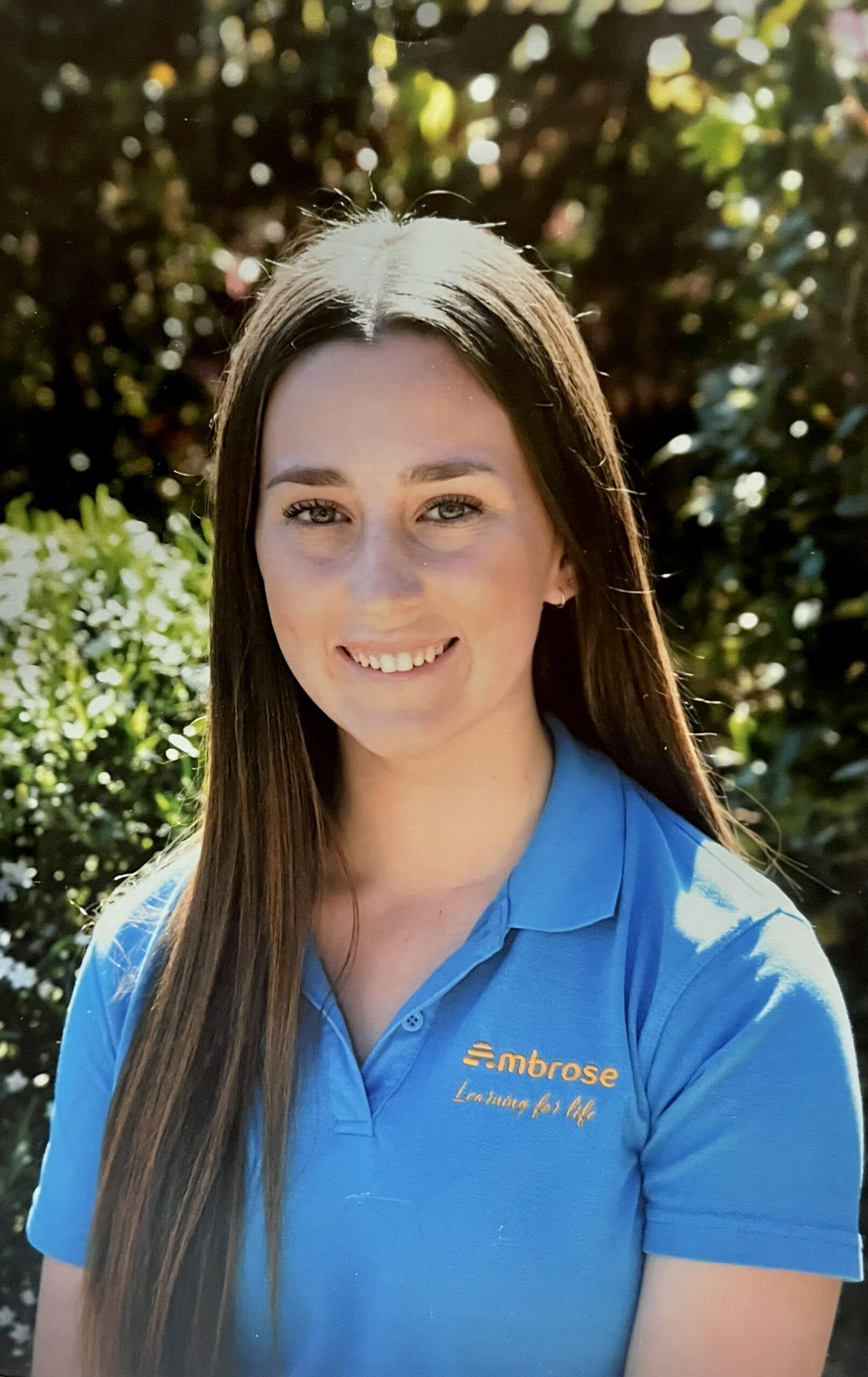
“If you’re looking for a rewarding job, working with children and creating meaningful relationships with not only the children and their families, but the staff and wider community, then this is the place.”

Sophie: Growing a Career Where It All Began

For Sophie, a career at Ambrose started in a place that was already very familiar to her.

She began her journey as a School-Based Trainee in the Preschool at Ambrose St John XXIII, located on the same campus where she attended both primary and high school. Working as an educator at St John XXIII is full-circle moment, growing her early learning career in a community that has played such an important role in her own upbringing and education.

Being surrounded by familiar faces made the transition from student to educator both exciting and rewarding. Sophie even found herself caring for the children of teachers who had once taught her, creating a unique connection to the community she had been part of for so many years.

What Sophie enjoys most about working at Ambrose is the strong sense of community, connection and, of course, the children.

“The children are my biggest motivation,” Sophie says. “They have the most fabulous personalities. They greet me with cuddles, drawings they’ve created, or simply excitement to see me. The children I’ve worked with over the past four and a half years inspire me to be better every day.”

While completing her Certificate III in Early Childhood Education and Care, Sophie gained valuable hands-on experience and developed the skills and confidence needed to grow her career. After successfully completing her qualification, she progressed into a full-time Cert III Educator role before undertaking a full-time Diploma traineeship. On completion of her Diploma she continued her professional growth, becoming a Diploma Qualified Educator and taking on the additional responsibility of Responsible Person. Having completed two traineeships, Sophie’s career journey highlights the valuable opportunities available at Ambrose for educators who are eager to learn and develop.

A key part of Sophie’s success has been the encouragement and support she has received from her colleagues and mentors. She credits Service Director, Tania, as a significant influence on her development, describing her as a supportive leader who genuinely cares about the wellbeing and success of her team. Through Tania’s guidance and mentorship, Sophie has been encouraged to challenge herself, continue learning and pursue new opportunities for growth.

Looking back, Sophie is incredibly proud of how far she has come. What started as a school-based traineeship on the same campus where she once attended school has grown into a rewarding career in early childhood education, allowing her to give back to the community that helped shape her own journey.

Faith, Belonging and Community

Grounded in the Catholic faith and open to all, our learning communities welcome families from all backgrounds, cultures and faith traditions.

Guided by the values of Respect, Encouragement and Care, educators support children to:

  • Develop kindness, empathy and gratitude
  • Build respectful relationships
  • Care for others and the environment
  • Develop confidence and a sense of belonging
  • Recognise and value diversity within the community

Faith and spirituality are experienced in age-appropriate and meaningful ways through:

  • Prayer and reflection
  • Stories, celebrations and traditions
  • Shared values and respectful relationships
  • Participation in school and community events
  • Experiences of care, inclusion and belonging

Educators nurture children’s natural sense of curiosity, wonder and connection to the world around them while supporting them to grow as caring, thoughtful and respectful individuals.

As part of a Catholic community, children experience opportunities to build connections with:

  • Educators and families
  • School and parish communities
  • Cultural and community celebrations
  • Shared events and experiences
  • The wider world around them

Transitioning to Kindergarten

At Ambrose, transition to school is viewed as a gradual and supportive journey where children build confidence, familiarity and a sense of belonging before their first day of school.

Throughout the year, educators intentionally support children to develop:

  • Confidence participating in group learning experiences
  • Listening and communication skills
  • Independence and self-help skills
  • Emotional regulation and resilience
  • Attention, persistence and flexible thinking
  • Positive relationships and social confidence
  • Familiarity with routines and transitions


Families are supported throughout the transition process through:

  • Ongoing communication and transition discussions
  • Parent-teacher interviews and learning updates
  • Transition to School Statements
  • Opportunities to connect with educators and school communities

Social and Emotional Development

At Ambrose, children are part of a connected Catholic school community where relationships, belonging and wellbeing are intentionally nurtured every day.

Grounded in the values of respect, encouragement and care, our nurturing learning environments support children to feel:

  • Safe and supported
  • Confident to participate and try new things
  • Connected to others and their community
  • Valued as capable learners
  • A strong sense of identity and belonging


Social and emotional learning is embedded throughout the day through:

  • Collaborative play experiences
  • Group discussions and reflection
  • Intentional teaching moments
  • Problem solving and conflict resolution
  • Structured routines and expectations
  • Prayer, wellbeing and relationship building


Through intentional play-based learning, structured routines and shared experiences, children develop:

  • Confidence and independence
  • Positive relationships and friendships
  • Emotional awareness and self-regulation
  • Resilience
  • Communication and collaboration skills
  • Respect, empathy and kindness

Mathematical Thinking and Inquiry

At Ambrose, mathematical thinking is developed through intentional play-based learning, inquiry, investigation and hands-on learning experiences that encourage children to explore, question and problem solve.

The Ambrose Foundations program supports children’s learning about mathematical concepts and applying them in their play and inquiries including STEAM experiences, construction, investigation and collaborative learning.

Children become familiar with:

  • Patterns and predictions
  • Shapes and spatial thinking
  • Measurement and data
  • Quantity and counting


Teachers intentionally plan for children’s Mathematical Inquiry and thinking, supporting children to develop:

  • Early number awareness
  • Problem solving and critical thinking
  • Pattern recognition
  • Spatial awareness
  • Reasoning and prediction skills
  • Confidence exploring mathematical concepts
  • Curiosity and inquiry skills

Language and Literacy

Strong literacy foundations begin with language, communication and connection. Children develop literacy skills through meaningful, hands-on experiences that connect learning to their everyday lives, interests and the natural world.

As part of the Catholic school community, Ambrose supports literacy development through a seamless continuum of learning from early childhood into kindergarten and the early years of school.

Through intentional play-based learning and literacy experiences, children build the confidence, communication skills and early learning foundations that support a successful transition into school.

  • This approach fosters the development of:
  • Oral language and communication skills
  • Vocabulary and comprehension
  • Listening and attention skills
  • Confidence participating in group discussions
  • Early literacy understanding
  • Phonological awareness
  • Curiosity about books, stories and language