
Understanding "My Time, Our Place" in OSHC

Framework for School Age Care in Australia

My Time, Our Place is Australia’s national learning framework for Outside School Hours Care. The framework guides educators in supporting the wellbeing, learning, and development of children aged 5–12 in before school, after school, and vacation care programs. It aligns with the National Quality Standards and complements the Early Years Learning Framework (Birth-5).

A Flexible, Play-Based Approach
Rather than delivering a formal or fixed curriculum, the My Time, Our Place approach is flexible, play-based, and child-centered. While the approach is not based on a formal curriculum, it is highly intentional. My Time, Our Place is flexible and play-based, recognising that children learn best when they have agency, choice, and space to explore.

Emergent Programming
The program is emergent—meaning educators plan, adapt, and reflect based on the interests, choices and developmental needs of the children. Every experience is underpinned by five learning outcomes: identity, connection, wellbeing, confidence, and communication.

The integrated connections of the Vision, Principles, Practices and Outcomes that centre on children and young people’s wellbeing, learning and development.

Examples of Learning in Action
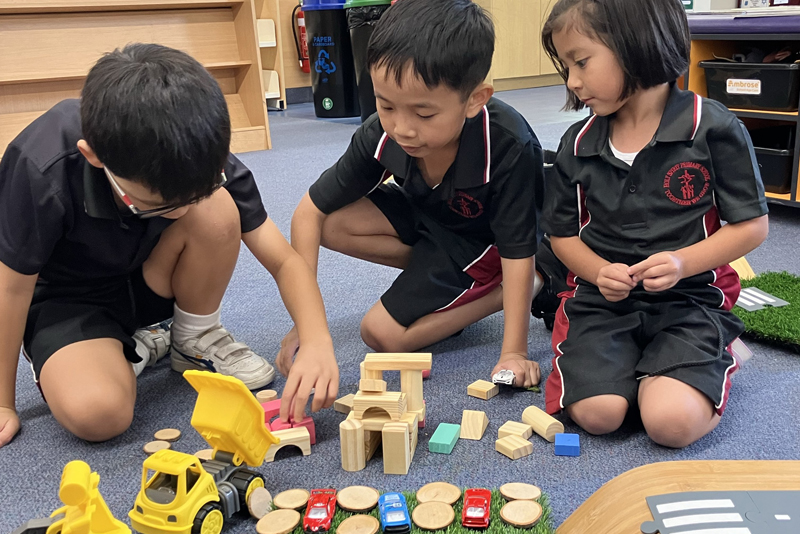
To give a clearer picture: in one area of the room, a group of children might be deeply engaged in constructing a marble run using recycled materials – developing problem-solving and teamwork skills. Outside, others are playing team games, learning cooperation and self-regulation. Meanwhile, another group is in the kitchen making fruit kebabs, building fine motor skills and learning about nutrition. There’s a quiet corner set up with mindfulness colouring and books for those needing downtime after a long school day. These experiences are not random, they’re intentionally planned and documented by educators to support individual and group development.

Choice, Autonomy, and Social Growth
From the outside, it might appear that children are simply running around the playground, moving from one station to another, chatting in groups, or choosing not to join a structured activity. What looks like unstructured movement is actually a reflection of children being given choice and autonomy in how they engage. This freedom fosters engagement, responsibility, independence, and social growth.

A child might choose to spend time experimenting with loose parts to build a fort, while others join a spontaneous dance-off. Some might prefer quiet conversation in a shaded outdoor area, while another small group works together to plan a mini talent show. These aren’t random or chaotic moments, they’re opportunities for learning, problem-solving, and developing key life skills.

Educator Role and Intentional Planning
All experiences are intentionally planned and scaffolded by educators in alignment with My Time, Our Place, taking into account children’s interests, developmental needs, and the learning outcomes they’re working towards. Educators observe, guide, and reflect on these experiences to ensure every child is supported to grow and thrive.

Share This Post

More To Explore

My Time, Our Place

Understanding “My Time, Our Place” in OSHC Framework for School Age Care in Australia My Time, Our Place is Australia’s national learning framework for Outside
Read More »