About Ambrose

Ambrose Centres are positive places where children flourish, parents feel supported and staff love to be.

We are a social enterprise of the Community Ventures, a not-for-profit charity supporting families of all religious beliefs in Sydney’s West, Hills District and Blue Mountains.

Ambrose offers best-practice, faith-based Early Learning, School Age Care and Vacation Care guided by Catholic values of Respect, Encouragement, and Care.

Your children are cared for by qualified, diligent and capable educators who use their unique qualities and experience to improve the learning outcomes of each child and inspire learning for life.

We believe that children organise and make sense of their social worlds through play, so we use innovative, play-based learning opportunities.

Our daily program is guided by children’s interests, abilities, knowledge and culture. Your children will learn through “hands on” experiences that involve doing, creating, experimenting, predicting, imagining, achieving, and investigating.

Respect
We are respectful and inclusive, maintaining integrity, honesty and openness in all that we do.
Click Here
Encouragement
We bring out everyone's personal best. Encouraging one another to grow, learn and develop through strong relationships and best practice Education and Care that is fun, creative and challenging.
Click Here
Care
We care for each other, nurturing individuality to create a sense of belonging in safe, respectful environments where treasured memories are made.
Click Here

Not just services for all Catholics, but Catholic services for all

Our Name
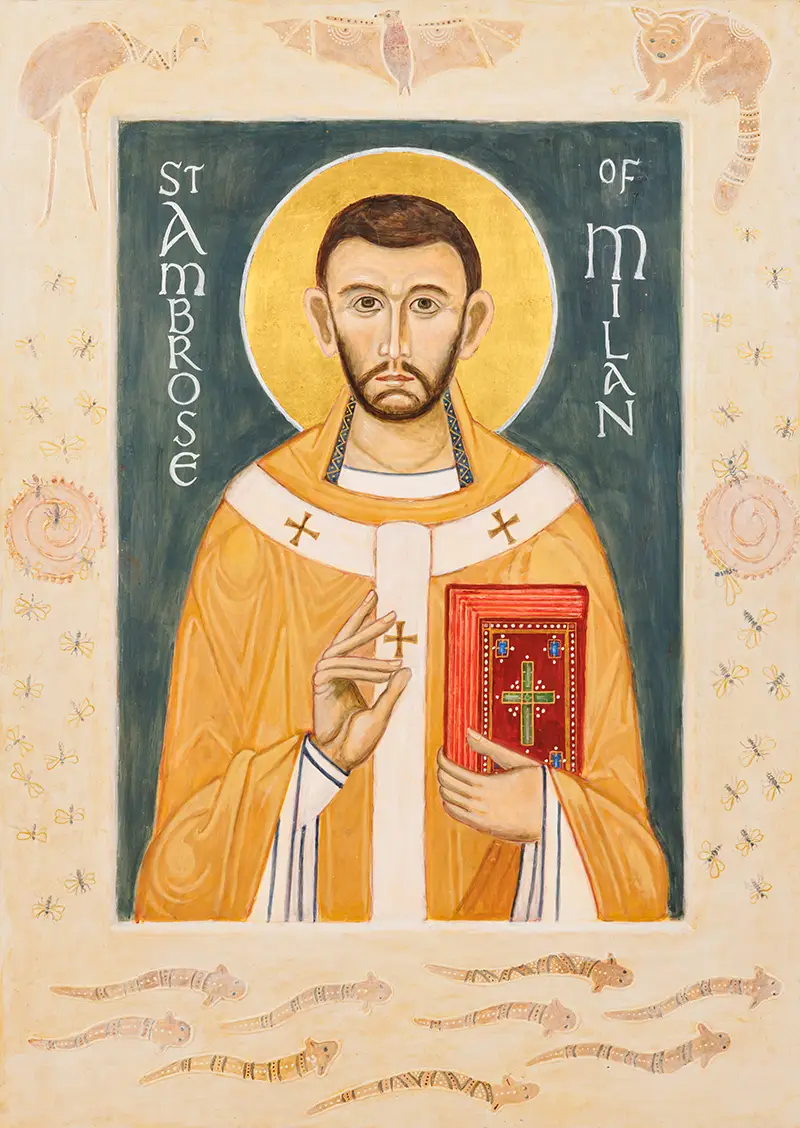
St Ambrose in Parramatta (Icongrapher: Mary Clancy. Indigenous artwork design: Leanne Watson)

Our name honours St. Ambrose (c. 340–397).

Saint Ambrose is a Doctor of the Church. He was the Bishop of Milan, a renowned scholar, hymn writer, and the Patron Saint of Learning and Beekeepers.

He is known for his compassion for children, captives and the poor. Some believe that when Ambrose was an infant, a swarm of bees visited him and left a single sweet drop of honey on his lips.

To his father, this was a sign that Ambrose would become an eloquent orator, with words “as sweet as honey”. For this reason, he is often portrayed with bees and holding a beehive.

This imagery is central to Ambrose.

The beehive is a safe, communal structure – a hive of activity where many honey bee species live, work and raise their young.

The ‘A’ of our logo is an open-door beehive. It symbolises the safe, nurturing community nature of Ambrose – open to all families regardless of their religion or the Primary School their child will attend.

The hexagonal cells of the honeycomb fit together perfectly to create one of nature’s strongest structures. They represent the strong, secure, and inclusive environments of our services.

St Ambrose in Parramatta

Renowned iconographer, Mary Clancy, was asked to write an icon of St Ambrose of Milan, the patron saint of Ambrose Early Years Education and School Age Care.

The icon, St Ambrose in Parramatta, is rich in tradition and symbolism.

Ambrose is shown wearing a toga, signifying his former life as a Roman official. His role as Bishop of Milan is expressed through the pallium and his priestly vestments. He holds the book of the Gospels as a sign of his renown as a preacher, while his hand gesture and the blackboard background reveal his identity as a learned teacher. The resplendent halo behind his head symbolises his divinity and eternal life.

The border places St Ambrose within the Diocese of Parramatta.

At the base, the gathering of little eels symbolises Parramatta itself. The emu, flying fox and possum across the top are totems of the Darug and Gundungurra peoples, who have inhabited Western Sydney and the Blue Mountains for tens of thousands of years. The blue-banded native bees and their hives serve as a reminder that St Ambrose is recognised as the patron saint of beekeepers, as well as of learning.

“I appreciate how you included both the creatures native to Australia and the bees that so richly symbolise Ambrose.

This speaks to the universal call to find God in all of creation while honouring the particular gifts of your Australian context.

For me, this is beautiful because, just as bees work together to create something sweet and life-giving, your Ambrose centres nurture communities where children can grow and flourish together.”

– Professor dr. Didier Pollefeyt
Full Professor, Faculty of Theology and Religious Studies Katholieke Universiteit Leuven.

The Iconographer – Mary Clancy

Mary Clancy joined the Varroville OCDS community – lay people living the Carmelite spirit – in 2009, and made her definitive promise in 2015.

She felt drawn to iconography for some time. In 2011, Mary attended a weekend course at the Mount Carmel Retreat Centre in Varroville, presented by Melbourne iconographer Anna Prifti. The following year, she began pursuing iconography more seriously, first studying with Anna, and then with Philip Davydov and Olga Shalmova, who travel annually from St Petersburg to Australia.

Carmelite and icongrapher Mary Clancy with Most Reverend Vincent Long Van Ngyen OFM Conv Bishop of Parramatta.

"Just as honey from the comb is sweet on your tongue, you may be sure that wisdom is good for the soul. Get wisdom and you have a bright future."

Proverbs 24: 13-14

From the Bishop of Parramatta

Dear friends and colleagues,
 
I am delighted to announce that the Diocese of Parramatta has expanded the pastoral outreach of our parish and school communities, through the creation of a new diocesan agency, Catholic Diocese of Parramatta Services Limited (CDPSL).
 
Now renamed Community Ventures, this expanded pastoral outreach includes, but is not limited to: a system of Catholic early childhood services; providing social enterprise services; and undertaking any other services related to these activities.
 
Community Ventures will be mandated with expanding our mission to serve the people of Western Sydney and the Blue Mountains by providing a range of services that support the needs of families with young children.
 
Existi​​ng Catholic Out of School Hours Care, Catholic Early Learning Centres – will transition into the newly-established CDPSL over the coming months.
 
Yours fraternally in Christ,
 
Most Reverend Vincent Long Van Ngyen OFM Conv
Bishop of Parramatta

Preschool for ages 3-5

OSHC & Activities for K-6

School years K-6

Faith, Belonging and Community

Grounded in the Catholic faith and open to all, our learning communities welcome families from all backgrounds, cultures and faith traditions.

Guided by the values of Respect, Encouragement and Care, educators support children to:

  • Develop kindness, empathy and gratitude
  • Build respectful relationships
  • Care for others and the environment
  • Develop confidence and a sense of belonging
  • Recognise and value diversity within the community

Faith and spirituality are experienced in age-appropriate and meaningful ways through:

  • Prayer and reflection
  • Stories, celebrations and traditions
  • Shared values and respectful relationships
  • Participation in school and community events
  • Experiences of care, inclusion and belonging

Educators nurture children’s natural sense of curiosity, wonder and connection to the world around them while supporting them to grow as caring, thoughtful and respectful individuals.

As part of a Catholic community, children experience opportunities to build connections with:

  • Educators and families
  • School and parish communities
  • Cultural and community celebrations
  • Shared events and experiences
  • The wider world around them

Transitioning to Kindergarten

At Ambrose, transition to school is viewed as a gradual and supportive journey where children build confidence, familiarity and a sense of belonging before their first day of school.

Throughout the year, educators intentionally support children to develop:

  • Confidence participating in group learning experiences
  • Listening and communication skills
  • Independence and self-help skills
  • Emotional regulation and resilience
  • Attention, persistence and flexible thinking
  • Positive relationships and social confidence
  • Familiarity with routines and transitions


Families are supported throughout the transition process through:

  • Ongoing communication and transition discussions
  • Parent-teacher interviews and learning updates
  • Transition to School Statements
  • Opportunities to connect with educators and school communities

Social and Emotional Development

At Ambrose, children are part of a connected Catholic school community where relationships, belonging and wellbeing are intentionally nurtured every day.

Grounded in the values of respect, encouragement and care, our nurturing learning environments support children to feel:

  • Safe and supported
  • Confident to participate and try new things
  • Connected to others and their community
  • Valued as capable learners
  • A strong sense of identity and belonging


Social and emotional learning is embedded throughout the day through:

  • Collaborative play experiences
  • Group discussions and reflection
  • Intentional teaching moments
  • Problem solving and conflict resolution
  • Structured routines and expectations
  • Prayer, wellbeing and relationship building


Through intentional play-based learning, structured routines and shared experiences, children develop:

  • Confidence and independence
  • Positive relationships and friendships
  • Emotional awareness and self-regulation
  • Resilience
  • Communication and collaboration skills
  • Respect, empathy and kindness

Mathematical Thinking and Inquiry

At Ambrose, mathematical thinking is developed through intentional play-based learning, inquiry, investigation and hands-on learning experiences that encourage children to explore, question and problem solve.

The Ambrose Foundations program supports children’s learning about mathematical concepts and applying them in their play and inquiries including STEAM experiences, construction, investigation and collaborative learning.

Children become familiar with:

  • Patterns and predictions
  • Shapes and spatial thinking
  • Measurement and data
  • Quantity and counting


Teachers intentionally plan for children’s Mathematical Inquiry and thinking, supporting children to develop:

  • Early number awareness
  • Problem solving and critical thinking
  • Pattern recognition
  • Spatial awareness
  • Reasoning and prediction skills
  • Confidence exploring mathematical concepts
  • Curiosity and inquiry skills

Language and Literacy

Strong literacy foundations begin with language, communication and connection. Children develop literacy skills through meaningful, hands-on experiences that connect learning to their everyday lives, interests and the natural world.

As part of the Catholic school community, Ambrose supports literacy development through a seamless continuum of learning from early childhood into kindergarten and the early years of school.

Through intentional play-based learning and literacy experiences, children build the confidence, communication skills and early learning foundations that support a successful transition into school.

  • This approach fosters the development of:
  • Oral language and communication skills
  • Vocabulary and comprehension
  • Listening and attention skills
  • Confidence participating in group discussions
  • Early literacy understanding
  • Phonological awareness
  • Curiosity about books, stories and language